


At enlightenbio, we are deeply committed to studying longevity and health span, which aligns with our personal and professional interests in biological science. For more on this, please see a couple of earlier publications: A Look at Human Longevity & Life Expectancy, Strong Grip, Strong Future: A Key Predictor of Healthy Aging, and Germany Calls for a Policy Shift to Address their Country’s Aging Population. As dedicated masters endurance athletes, both myself and founder Brigitte Ganter are personally invested in research relating to diet, exercise, recovery, metabolism, and health. With these interests in mind, we were both highly intrigued by the recently published full multi-omic analysis of the then world’s oldest verified living person (Santos-Pujol et al., 2025). This Catalonian resident female, Maria Branyas Morera, was 116 years and 74 days old at the time of the analysis and was referred to in the study by the shorthand M116. Supercentenarian Maria Branyas Morera (i.e., M116) died at the age of 117 years and 168 days on September 25, 2025.
Although this study received significant media attention upon its announcement, we believe the findings remain compelling and would like to outline some key features of the multiomics profile here.
When Short Telomeres Don’t Mean Short Life – A Molecular Paradox of Longevity
Telomere length is implicated in both lifespan and age-related illness (López-Otin et al., 2023). Therefore, Santos-Pujol and team (2025) analyzed the telomere structures of subject M116. Opposite to what was expected, M116’s telomeres displayed the shortest mean length (approximately 8kb) among all the health subjects measured in the study. Furthermore, M116’s telomeres fell into the lowest twenty percentile of lengths measured. These results appear counterintuitive to the prevailing notion of telomere length as a predictor of overall health. The authors proposed an alternative explanation: in the case of M116, who maintained overall good health, telomere length functioned only as a molecular aging clock. They suggested that the presence of ultra-short telomeres was potentially protective by limiting the replicative lifespan of any emergent malignancy.
“M116 exhibits ultra-short telomeres, which was suggested to be potentially protective by limiting the replicative lifespan of any emergent malignancy.”

Credit: Santos-Pujol et al. (2025)
The Genomic Signature of Longevity: Rare Variants in Neuroprotection, DNA Repair, and Mitochondrial Function
On the basic assumption that M116 might be carrying one or more genetic mutations that contribute to her extreme longevity the authors performed whole genome sequencing of M116 and identified 3.8 million single nucleotide variants (SNV). These variants were screened and filtered to pinpoint novel and notable changes.
Significant variants were found in several key areas:
- Cognitive and Immune Function: Variants were found in DSCAML1, a gene associated with cognition and immune function, and MAP4K3, a gene linked to lifespan in C. elegans.
- Neuroprotection: Variants in NSUN5 and TTBK1 were of particular interest due to their links to neuroprotection, potentially contributing to M116’s preserved cognitive function.
- DNA Repair: A rare variant in the TIMELESS DNA repair gene, which has been associated with longevity in Drosophila.
- Pulmonary Function: Variants were observed in TSPYL4 and NT5DC1, which related to pulmonary function.
- Aging Brain and Heart: Variants were found in protocadherin alpha cluster genes (PCDHA1-9), which relate to health of aging brains and heart disease.
- Lipid Metabolism and Heart Function: Variants were identified in LRP1 and LRP2, which play roles in lipid metabolism and heart function.
Additionally, M116 carried rare variants in five genes involved in mitochondrial function: ND5, COX1, MTG2, MTCH2 and MRPS9. Given the known connection between mitochondrial metabolism, reactive oxygen species (ROS) generation, health, aging, and disease (see also: The Multifaceted and Sometimes Paradoxical Nature of Reactive Oxygen Species in Cancer), this constellation of variants may be especially significant and and could affect mitochondrial oxidative phosphorylation. Bolstering this potential mitochondrial link, analysis of M116’s peripheral blood mononuclear cells (PBMCs) showed that both membrane potential and superoxide ion levels were higher than those observed for younger women.
The Gut-Longevity Connection, or A Youthful Microbiome at 116
The status of the human microbiome is strongly correlated with health, aging, and disease (López-Otin et al., 2023) (see also: The Role of the Human Gut Microbiome in Alzheimer’s Disease Development). The analysis of M116’s microbiome revealed several notable features. Specifically, M116’s exhibited a high alpha-diversity (within sample diversity) compared to the control female population. M116 also showed a high relative abundance of the genus Bifidobacterium (within the family Bifidobacteriaceae, phylum Actinobacteriota). This is a particularly striking feature, as levels of these microbes typically decline in older subjects. Instead, M116’s profile is consistent with reports of relatively higher levels found in centenarians and supercentenarians (Santos-Pujol et al., 2025). Higher levels of Bifidobacterium have also been correlated with lower inflammation and healthy lipid metabolism. The authors noted that M116 ingested three yogurts per day and generally followed a Mediterranean-style diet for the last 20 years at her living facility. These dietary habits are considered potential contributors to the observed microbiome profile, though data regarding lifelong habits or changes was not available.

Credit: Santos-Pujol et al. (2025) Mediterranean Diet excerpt of Table S15
The Youthful Epigenome
The epigenetic marker of DNA methylation changes during aging, often showing a trend of global hypomethylation, though specific regions (like tumor suppressor loci) may become hypermethylated (López-Otin et al., 2023). Analysis of M116’s DNA methylome revealed several striking features:
- Repetitive Element Methylation: The repetitive DNA elements of M116, specifically those from three major families (LINE-1, ALU and endogenous retroviral sequence, were relatively hypermethylated). This level was higher than that typically observed in most younger individuals. It is hypothesized that epigenetical silencing of these elements may confer a longevity advantage.
- Epigenetic Age: When Santos-Pujol and team (2025) applied several of the recently developed “epigenetic clock” models to the supercentenarian’s DNA methylation data, M116 consistently exhibited a biological age that was younger than her actual chronological age.
“M116 exhibited a young-mimicking epigenome, younger than her actual chronological age.”

Credit: Santos-Pujol et al. (2025) PBMC analysis from Figure 2.
Young Blood, Old Cells – The Dual Nature of Immunity and Metabolism in Longevity
Using single cell transcriptomics (scRNA-seq) of PBMCs, M116 exhibited an expanded presence of age-associated B Cells (ABC). Additionally, the subject showed relatively higher proportions of senescent T cells and lower naive T cells. Critically, the levels for ABCs, senescent T cells, and naive T cells were all determined to be extreme outliers relative to the control groups. In stark contrast to these immunological markers, M116 displayed very healthy blood chemistry and lipid profiles, including extremely low levels of VLDL-cholesterol, high HDL-cholesterol, and very favorable cholesterol particle size distribution. These positive metabolic markers were further complemented by low levels of inflammation markers detected in the blood.
“M116 exhibited an efficient lipid metabolism and strong mitochondrial health.”
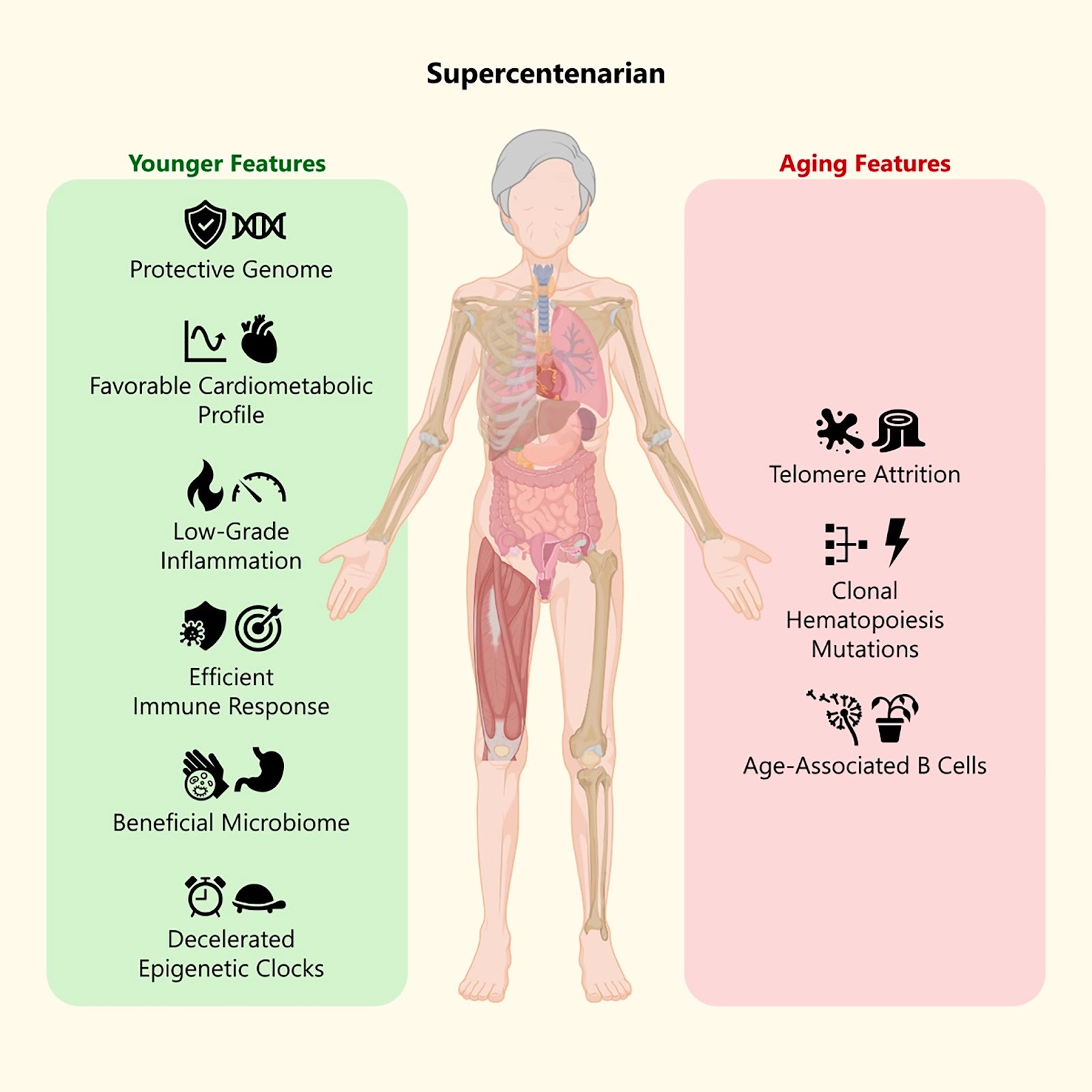
Credit: Santos-Pujol et al. (2025)
Lessons from a Life Well Lived
When considering the full scope of M116’s molecular profile, a fascinating picture of contrasts emerges.
Several indicators, including her ultra short telomeres, immune cell population, and the presence of clonal hematopoiesis of indeterminate potential (CHIP, a potential precursor for certain malignancies), align with her advanced chronological age. Yet, these hallmarks are balanced by equally clear indicators of good health and biological youth, specifically a young-mimicking epigenome, a diverse and inflammation-resistant microbiome and beneficial genetic variants. Together, these traits suggest that longevity is not simply the absence of aging, but the results of a finely tuned balance between molecular wear and systemic resilience. We believe these factors, coupled with efficient lipid metabolism and strong mitochondrial health, may be critical in explaining healthspan and status as a supercentenarian.
References
López-Otin et al., Hallmarks of aging: An expanding universe. (2023) Cell, 2023 Jan 19;186(2):243-278.
Santos-Pujol et al., The multiomics blueprint of the individual with the most extreme lifespan. (2025) Cell Rep Med, Sep 24:102368. doi: 10.1016/j.xcrm.2025.102368.