

Mithrl has announced a $20 million Series A, led by Obvious Ventures, with participation from Headline, AGI House, and several pharmaceutical executives. The announcement brings up an increasingly important challenge in biopharma R&D: how to help scientists make sense of increasingly complex experimental data and get to meaningful, defensible decisions faster. Mithrl’s answer to that challenge is its AI-powered Scientific Decision Engine.
This one is actually a little personal for me. I had the opportunity to work with Mithrl as a contractor for a short period, supporting the team on product and go-to-market strategy. It was a genuinely enjoyable experience working with a team that combines deep scientific expertise with a lot of curiosity, energy, and very smart thinking. It also gave me a closer look at the problem they are trying to solve, and why I think it is an important one.
Mithrl sits in the rapidly growing scientific AI market, but what I find particularly interesting is that the company is not simply trying to build another AI assistant for scientists. Rather it focuses on a much harder problem: How do you help scientists turn increasingly complex experimental data into insights they can actually use to make R&D decisions?
There Is no Shortage of Scientific Data
Biopharma companies today generate enormous amounts of data across genomics, transcriptomics, proteomics, single-cell sequencing, spatial biology, functional assays, and many other technologies. The challenge is increasingly what happens next, as the scientists need to process and analyze that data, determine which methods to use, integrate results across experiments, connect findings to existing biological knowledge and the scientific literature, and ultimately decide whether a signal is meaningful enough to pursue. That process can involve multiple scientists, bioinformaticians, tools, databases, and computational workflows. And while we have become remarkably good at generating biological data, getting from those data to a defensible scientific conclusion can still take considerable time.
“We have become remarkably good at generating biological data. The challenge is turning those data into defensible scientific conclusions and deciding what to do next.”
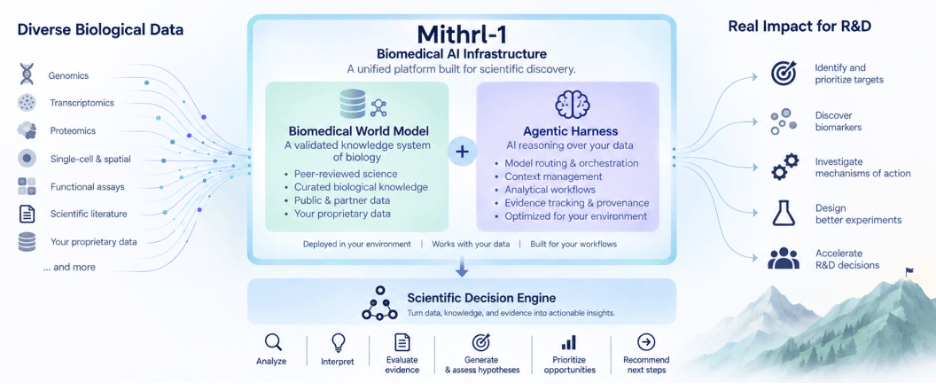
This is the gap Mithrl is addressing. Their stated mission is to help R&D teams move from idea to IND 50% faster, with the company saying: their platform accelerates R&D cycles between experiments by an average of 32-fold. Mithrl addresses this with their internally developed Scientific Decision Engine (SDE), which was designed to help scientists move from raw experimental data through analysis and biological interpretation to evidence-backed conclusions that can inform what they do next.
More Than Asking an AI a Scientific Question
There are now plenty of tools that allow scientists to ask questions of the literature or interact with scientific information through a chat interface. Those capabilities are useful, but drug discovery requires considerably more than generating a plausible answer.
Scientists need to know: Where did this conclusion come from? What data supports the finding? What analysis was performed and can I reproduce it? Do I trust it enough to run the next experiment based on the findings, or potentially a much larger R&D decisions?
Mithrl combines agentic AI with scientific knowledge and computational workflows to address these questions. Its applications include target identification and prioritization, biomarker discovery, biological interpretation of experimental results, and investigation of mechanisms of action. Importantly, the system supports the incorporation of a company’s own experimental data, internal knowledge, and existing workflows. This is important, as it means the AI is not reasoning only from public information or what a general-purpose model learned during training. It can reason in the context of what a particular R&D organization already knows and needs to integrate in downstream data analysis.
Building a Biomedical World Model
One of the fundamental challenges in scientific AI is giving an AI system access to the right scientific context. Biomedical knowledge is enormous, constantly changing, and distributed across publications, databases, experimental results, and a company’s own proprietary data. For an AI system to help with meaningful scientific decision-support, it needs more than access to a general-purpose language model. It needs a scientific knowledge layer that can ground its reasoning in biology and supporting evidence.
To address this challenge, Mithrl developed Mithrl-1, its biomedical world model, scientific knowledge layer, which connects structured biological knowledge and supporting evidence with an organization’s own experimental data, helping scientists investigate mechanisms, compare findings, and determine what to test next. Rather than relying solely on what a frontier model (e.g., ChatGPT, or Anthropic) learned during training, Mithrl-1 grounds scientific reasoning in the evidence and context of a specific research program.
According to the company, its biomedical world model provides 16 times more primary evidence per answer than frontier models alone. In an expert-rated benchmark, Mithrl reported a scientific-correctness score of 0.96 compared with 0.60 without its knowledge system. The company also reports an average 32-fold acceleration in discovery-analysis iterations across customer projects. While these are company-reported results, that will still require broader real-world validation, but they also highlight Mithrl’s goal: more grounded, evidence-backed scientific reasoning, not simply faster answers.
The Real Bottleneck May Be Deciding What to Pursue
Certainly, AI is making it dramatically easier to generate hypotheses and identify potential targets, biomarkers, pathways, mechanisms, and associations. But scientists cannot experimentally validate every possibility. As hypothesis generation becomes faster, the challenge increasingly shifts toward determining which findings are sufficiently supported by the data and existing biology to warrant further investigation.
This is where the value of a Scientific Decision Engine comes in. It isn’t simply in producing another list of potentially interesting findings. It is in helping scientists move from their experimental data through the necessary analyses, put those results into biological context, examine the supporting evidence, develop and evaluate hypotheses, and ultimately decide what deserves to be pursued next. And this matters, because every additional experiment requires time and resources, and decisions made early in discovery can ultimately determine where much larger investments are made. A system that can help scientists narrow the possibilities and make those decisions with stronger evidence could therefore have an impact well beyond simply making an individual analysis faster.
Mithrl says discoveries made through the platform have already resulted in at least half a dozen patent filings. Interestingly, the company notes that this was not an outcome it originally designed the platform to produce, but rather something that emerged as scientists began using it to look across biological evidence in new ways.
Mithrl’s Competitive Landscape
Scientific AI has become a crowded and fast-moving market, with companies approaching the problem from different directions. Some started with scientific knowledge and search, others with bioinformatics and data analysis, while general-purpose AI companies are increasingly moving into scientific workflows. These boundaries are becoming less distinct.
Causaly is one of the closer comparisons. Its platform combines biomedical knowledge, internal and external data, AI reasoning, and agentic workflows for applications including target identification, biomarker discovery, and R&D decision-making.
Phylo, through Biomni, takes a somewhat different approach, bringing AI agents, biological data, tools, and computational analysis together in an integrated environment for biologists.
Anthropic is coming at the problem from yet another direction. Claude for Life Sciences shows how general-purpose frontier models are expanding into scientific workflows, including literature research, bioinformatics, data analysis, and connections to scientific tools and data sources.
Prompt.bio starts more directly with biological data analysis, using AI to make complex bioinformatics and multi-omics analyses more accessible to scientists.
Companies such as Benchling, Owkin, and LatchBio overlap with Mithrl in other parts of the R&D workflow, including scientific data infrastructure, AI-enabled research environments, biological analysis, and scientific agents.
I would not consider all of these companies’ direct competitors of Mithrl. They approach the problem from different starting points and overlap with Mithrl to different degrees. But together they illustrate a broader shift in scientific AI: from relatively isolated data analysis and scientific chat toward systems that combine data, analysis, biological knowledge, and reasoning across larger parts of the scientific workflow.
Where I See Mithrl as Different
Mithrl is not a literature-search tool. It can work directly with experimental data and execute analytical workflows. It is also not simply a bioinformatics or data-analysis platform. The Mithrl platform connects computational results with biological knowledge and supporting evidence, interprets what those results mean, develops and evaluates hypotheses, and helps scientists determine what to do next. Instead of addressing just one part of that process, Mithrl is trying to connect these different layers and provide something closer to a scientific reasoning and decision layer for R&D.
A pharmaceutical company already has scientists, bioinformaticians, experimental platforms, databases, computational pipelines, internal datasets, and years – sometimes decades – of accumulated scientific knowledge. The question is not simply how to add AI to that environment. The more interesting question is: How can we help scientists bring all of this information together, make sense of it, and get to the next good decision faster?
That is the challenge Mithrl is trying to address. AI is the means to get there. It enables Mithrl to bring together scientific data, knowledge, analysis, and reasoning at a scale and speed that would otherwise be difficult to achieve. To me, that distinction between starting with the scientific problem and using AI as the means to solve it is important.
“The question is not simply how to add AI. It is how to help scientists bring data, knowledge, and evidence together and get to the next good decision faster. AI is the means to get there.”
What the Series A Could Enable
The $20 million Series A provides Mithrl with additional resources to expand deployments across larger organizations and continue developing the next generation of its platform. Mithrl has also described plans to expand across therapeutic areas including oncology, immunology, metabolic disease, diabetes, and cardiovascular disease.
But the announcement also comes at an interesting point for scientific AI. We are moving beyond the first wave of tools that primarily analyze individual datasets, summarize papers, answer questions, or generate individual predictions. The next generation is increasingly being asked to participate in much larger parts of the scientific workflow, working with proprietary data, performing analyses, connecting different sources of evidence, generating and evaluating hypotheses, and helping scientists determine what to do next. That raises the bar considerably.
Having worked briefly with the Mithrl team, I am particularly happy to see them announce this milestone. I enjoyed working with a group of people who brought together deep scientific expertise, curiosity, energy, and a real enthusiasm for solving difficult problems. I will be interesting to see where Mithrl takes the Scientific Decision Engine from here, and how this broader category of scientific AI develops.